

In our previous lesson, we focused on the 7 Elements of Digital Storytelling. So far, however, we’ve not discussed how exactly it can be applied given the variety of educational settings that exist. Digital storytelling offers a wide variety of applications for not only instructor-led training but also for online instruction, and e-learning training programs. The approach is also a powerful pedagogical tool, that can have a positive impact on the teaching and learning process as it presents content in a more engaging and more collaborative way as compared to traditional learning methods. It also transforms education delivery through the adoption of modern and more relevant strategies of teaching. Teachers, instructional designers, and course developers must, therefore, be aware of types of digital stories that can be used to support digital storytelling in both instructor-led and online learning environments. Robin (2006) identified three types of digital stories: personal narratives, historical documentaries, and content-based stories that inform or instruct. Watch the video below to learn more about these types of stories.
Source: Henry, J. (2020). Types of Digital Stories [YouTube Video].
When incorporating digital storytelling in the teaching and learning process, these types of stories can be presented in several different formats. Andrews, Hull, and Donahue (2011) have identified “four types of story-based instruction” that can be used to incorporate storytelling in learning design: (1) case-based, (2) narrative-based, (3) scenario-based, and (4) problem-based instruction (summarized in the image below). These methods can be applied in both instructor-led training and online environments.
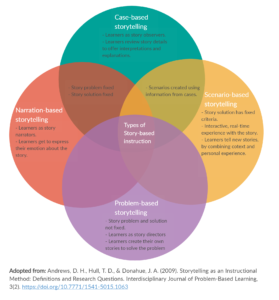
In summary, we can see that digital storytelling can be used in a wide variety of teaching applications for both classroom and online learning. When used in these applications, undoubtedly there will be several implications for not only learners but also for educators and instructional designers. In the next lesson, we’ll explore some of these implications.
Let’s Recap
References
Andrews, D. H., Hull, T. D., & Donahue, J. A. (2009). Storytelling as an Instructional Method: Definitions and Research Questions. Interdisciplinary Journal of Problem-Based Learning, 3(2). https://doi.org/10.7771/1541-5015.1063
Robin, B. R. (2006). The Educational Uses of Digital Storytelling. Retrieved from http://digitalstorytelling.coe.uh.edu/articles/Educ-Uses-DS.pdf
Leave A Comment