About J. Henry

This author has not yet filled in any details.
So far J. Henry has created 10 blog entries.

Lesson 1 – Introduction to Digital Storytelling

As humans, our ability to tell stories, throughout time and history has provided us with common ground, connections, and bonds that have been passed down from generation to generation. Stories in themselves, have come to signify hope for people who would otherwise not have imagined the world of endless possibilities to exist. In addition, stories often present compelling emotional elements that appeal to a wide variety of senses. The advent and dissemination of the information and communication technologies (ICT) ...
By |2020-04-05T22:43:53+00:00March 1st, 2020|Digital Storytelling|0 Comments

Lesson 2 – Defining Digital Storytelling

Before we delve into an exploration of digital storytelling as a pedagogical approach, it's important that we consider the concept of a ‘story.’ What exactly do we mean when we say a ‘story’? What is it that makes a story an effective pedagogical tool for teaching and learning? Since time immemorial stories have been used to convey meaning to humans, as they were often used as a means of passing down culture and tradition from generation to generation. Stories thus, ...

By |2020-04-26T00:10:28+00:00March 4th, 2020|Digital Storytelling|0 Comments

Lesson 3 – Elements of Digital Storytelling

The most extensively used framework for digital storytelling was developed by the Center for Digital Storytelling (CDS) in Berkeley, California. The framework identified 7 Elements of Digital Storytelling (summarized in the table below) that served as the basic starting point for those looking to create effective digital stories. Robin (2020) has further modified the new steps as posited by Lambert, noting that the approach presented lacked the specificities as it relates its applicability in educational environments, specifically stories that ...

By |2020-04-05T22:46:31+00:00March 7th, 2020|Digital Storytelling|0 Comments

Lesson 4 – Types of Digital Stories and Story-based Instruction

In our previous lesson, we focused on the 7 Elements of Digital Storytelling. So far, however, we’ve not discussed how exactly it can be applied given the variety of educational settings that exist. Digital storytelling offers a wide variety of applications for not only instructor-led training but also for online instruction, and e-learning training programs. The approach is also a powerful pedagogical tool, that can have a positive impact on the teaching and learning process as it presents content ...

By |2020-04-05T22:47:36+00:00March 9th, 2020|Digital Storytelling|0 Comments

Lesson 5 – Implications of Digital Storytelling

Digital Storytelling Implications for Learners Any discussion of digital storytelling and its implication for learners must draw attention to its pedagogical roots in constructivism. Constructivism is a learning approach that calls for the knowledge and experience of learners to become the focal point of knowledge dissemination (Fernando & Marikar, 2017, p.120). Fernando and Marikar (2017) further state that constructivism ensures that learners get practical knowledge through interaction, and by relating to new events. The theory rejects the notion that students ...

By |2020-04-05T22:48:52+00:00March 12th, 2020|Digital Storytelling|0 Comments

Lesson 6 – The Rise of Interactive Digital Storytelling (IDS)/Interactive Storytelling

As technology continues to evolve, instructional pedagogies have also evolved to keep pace. Digital storytelling is no exception to this rule, with the latest buzz being that of Interactive Digital Storytelling (IDS) or Interactive Storytelling as it is referred in some circles. Baldwin and Ching, (2017), argue that while “the terms ‘digital storytelling’ and ‘interactive storytelling’ are often used interchangeably,” interactive digital storytelling has the distinction of being an approach that allows learners to “actively interact with the material” ...

By |2020-04-06T04:23:14+00:00March 14th, 2020|Interactive Digital Storytelling (IDS)|0 Comments

Lesson 7 – Interactive Digital Storytelling (IDS)Techniques

In Lesson 4 – Types of Digital Stories and Story-based Instruction, we learned about the types of digital stories, and the four types of story-based instruction (techniques) that can be applied in digital storytelling (case-based, narration-based, scenario-based and problem-based). Although the techniques used in interactive storytelling may be similar, they, of course, have the distinction of being ‘interactive.’ A review of the literature has found that there are several interactive content types that can be used to present interactive story-based ...

By |2020-04-06T04:43:34+00:00March 17th, 2020|Interactive Digital Storytelling (IDS)|0 Comments

Lesson 8 – 3 Open-Source Tools for Digital and Interactive Digital Storytelling (IDS) – Part 1

If you are interested in creating your own interactive video, serious game or branching scenario there are several free and open-source tools, as well as paid tools that are available. In the lesson that follows, I will review 3 open-source tools, and provide examples of how they were used e-learning content. Part 1 of these lessons will focus on H5P. H5P H5P is a free feature-rich tool that allows anyone to create, share and reuse HTML5 content and applications. ...

By |2020-04-06T04:02:37+00:00March 20th, 2020|Interactive Digital Storytelling (IDS)|0 Comments

Lesson 9 – 3 Open-Source Tools for Digital and Interactive Digital Storytelling (IDS) – Part 2

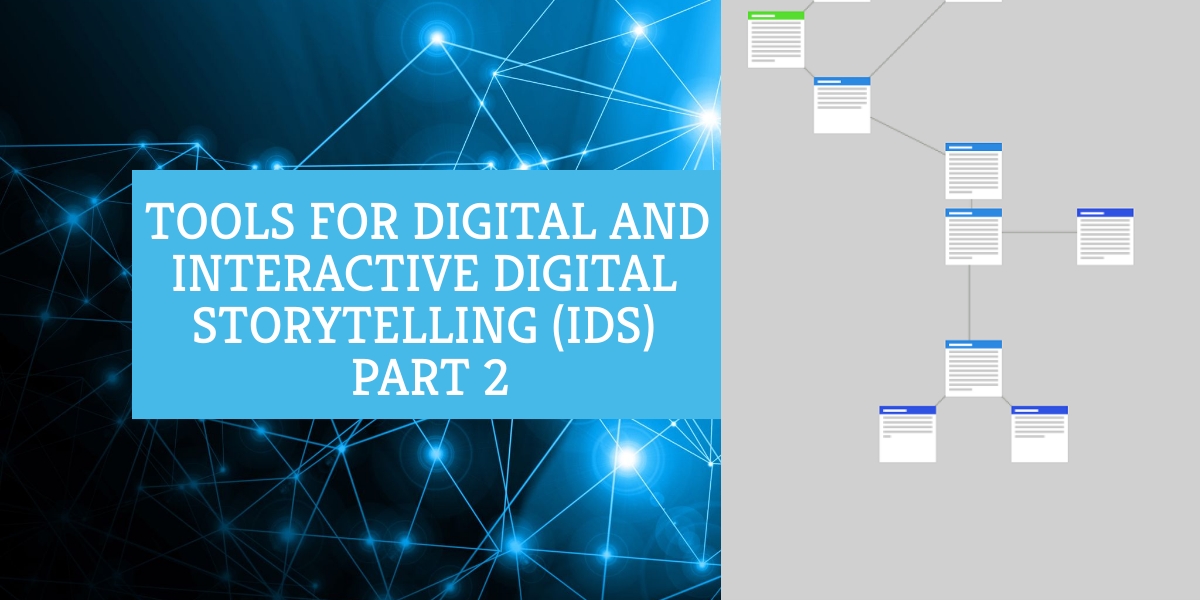
Twine In part 2 of this lesson, we will focus on Twine. Twine is a free and open-source tool that was initially created by Chris Klimas in 2009, to allow users to create interactive fiction in the form of web pages. Over the years, however, the tool has become a go-to for persons interested in creating interactive branching scenarios and narratives as well as non-linear stories. Twine allows anyone to create an adventure game, by mapping out all interactions and ...

By |2020-04-06T04:04:36+00:00March 23rd, 2020|Interactive Digital Storytelling (IDS)|0 Comments

Lesson 10 – 3 Open-Source Tools for Digital and Interactive Digital Storytelling (IDS) – Part 3

Godot Engine In this lesson, we will focus on Godot Engine. Godot is a free and open-source game engine released under the MIT license. It allows users to create 2D, 3D and cross-platform games. Features include a ‘flexible scene system,’ ‘visual editor,’ ‘friendly content creation pipeline,’ ‘persistent live editing, and ‘multi-platform deployment’ (Godot Engine, 2020). Example: Tiny White Cell Developed in 2017 by a team of first semester students at the S4G School for Games in Germany. The game ...

By |2020-04-06T04:21:31+00:00March 25th, 2020|Interactive Digital Storytelling (IDS)|0 Comments