

In Lesson 4 – Types of Digital Stories and Story-based Instruction, we learned about the types of digital stories, and the four types of story-based instruction (techniques) that can be applied in digital storytelling (case-based, narration-based, scenario-based and problem-based). Although the techniques used in interactive storytelling may be similar, they, of course, have the distinction of being ‘interactive.’ A review of the literature has found that there are several interactive content types that can be used to present interactive story-based instruction. This discussion, however, will focus on the following interactive content types, with a focus on the use of these techniques in e-learning environments:
- Interactive video,
- Serious games, and
- Branching scenarios (narratives, storylines).
While I will not provide an exhaustive analysis of the above techniques in the discussions that follow below, I will, however, attempt a cogent overview of each of the content types.
Interactive Video
As a technological tool, videos have for years provided teachers and instructional designers with an effective method of improving the teaching and learning process. Simply adding a video to a course, however, did not guarantee that the learning process improved. In recent times, however, improvements in information and communications technologies have created greater possibilities for the use of videos, particularly those that are ‘interactive.’ Gedera and Zalipour (2018) define interactive video as “videos that embed interactive learning moments in which deep learning can occur for students” (p. 363).

Kleftodimos and Evangelidis (2016) posit that “interactivity in educational videos is a relatively new trend with the level and types of interactivity to be in constant evolution” (p. 1). Interactive videos are widely used in e-learning environments, offering enhanced learning experiences through personalized learning content and realistic scenarios. Dongsong, Zhou, Briggs, and Nunamaker (2006) in their study which assessed the impact of interactive video on learning effectiveness found that there was a positive correlation between the use of interactive videos, learner satisfaction, and overall learning outcomes. Furthermore, their study found that the use of interactive video which allowed learners to have control over the content that they were able to access individually, allowed for even greater learner satisfaction and higher learning outcomes (Dongsong, Zhou, Briggs & Nunamaker, 2006).
The use of interactive videos thus provides learners with opportunities to further immerse themselves in the learning process. It is important to note, however, that for an interactive video to be an effective digital learning tool, it must be effectively pedagogically designed and developed (Gedera & Zalipour, 2018).
Serious Games
Several studies have shown that the use of digital games can have positive effects on learner engagement, motivation, and retention (Papastergiou, 2009; Erhel & Jamet, 2013). From the perspective of interactive storytelling, digital games can be viewed as a form of “visual storytelling,” that offers several advantages to learners when effectively deployed. For e-learning courses, the use of digital games provides learners with the opportunity to progress through stories, while at the same time working towards a learning goal, interacting with the gaming elements and competing with other learners (Lasola-Caramol, 2016). Based on the principle of situated cognition, game-based learning allows learners to effectively apply their knowledge while learning with the interactive game and in doing so learners play a more active (rather than passive) role in their own learning. Chen (2017) in his study on the Effect of Digital Game-Based Instruction on Students’ Learning Motivation and Achievement found that the introduction of digital games over a short period of time led to improvements in learner motivation and achievement.

In recent years, digital gaming as evolved into so-called ‘serious games,’ which have allowed for the development of stories that offer even greater levels of interactivity, through a combination of gaming and learning. While I will restrain from examining the definitional nuisances presented in the literature when attempting to define what exactly a ‘serious game’ is, I’ve summarized some common definitions in the table below.
| Author | Definition |
|---|---|
| Laamarti, Eid, Saddik and Thalmann (2014) |
Serious games are applications that use “three components: experience, entertainment, and multimedia” (p. 4) |
| Marsh (2011) | Serious games are “digital games, simulations, virtual environments, and mixed reality/media that provide opportunities to engage in activities through responsive narrative/story, gameplay or encounters to inform, influence, for well-being, and/or experience to convey meaning” (p. 63). |
| Michael and Chen (2006) | “A serious game is a game in which education (in its various forms) is the primary goal, rather than entertainment” (p. 17). |
| de Freitas (2006) | Education games are “…applications using the characteristics of video and computer games to create engaging and immersive learning experiences for delivering specified learning goals, outcomes and experiences” (p. 10) |
While the definitions presented are clearly not an exhaustive list of the definitions that exist for serious games, what is clear though is that serious games, unlike regular video games, go beyond the entertainment factor. The definition that stands out for me is the one presented by Marsh (2011) as it recognized the multiple approaches (i.e. “digital games, simulations, virtual environments, and mixed reality/media”) that can be used individually or combined to create an educationally sound serious game. For interactive storytelling, the use of serious games thus offers a wide variety of applications. Serious games that use the simulation, for example, allow learners to be fully immersed in interactive stories (narratives) that are presented to the learner. Reeve (2009) posits that “serious games have clear objectives for player achievement that are transferable to spaces outside the game world” (p. 74). He further goes on to state that, “within serious games, the role of the narrative becomes more pronounced because of the requirement to deliver specific learning outcomes” (Reeve, 2009, p. 74).
Branching Scenarios (Narratives, Storylines)
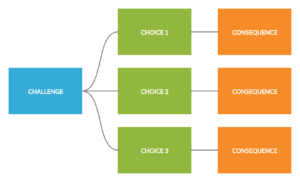
Branching scenarios (narratives, storylines) have become an increasingly popular technique used in the development of interactive digital stories. Snegirev (2016) defines a branching scenario is an “interactive form of learning,” that “challenges the learner, requires them to make a decision, and then presents the consequences” (para. 2). The use of branching scenarios (narratives, storylines) allows learners to be presented with the consequences of their actions. This will enable them “to understand whether the particular outcome is good or bad and whether it could be improved in another attempt at playing through the branching scenario” (Snegirev, 2016, para. 7). Others such as Riedl and Bulitko (2013) share similar sentiments, noting that the overall aim of this type of narrative is to allow learners to be fully immersed in a world where their actions will ultimately determine how the story unfolds.
Additionally, by presenting the consequences of the learner’s actions, branching scenarios enable “learners to understand whether this particular outcome is good or bad and whether it could be improved in another attempt at playing through the branching scenario” (Snegirev, 2016, para. 7). The distinguishing feature that separates branching scenarios (narratives, storylines) from other forms of multimedia entertainment is the fact that the approach allows learners to determine how the story ultimately progresses (Riedl and Bulitko, 2013). This is done by presenting the learners with a “challenge”, “choices”, and “consequences” which are often referred to as the 3Cs of branching scenarios (Kuhlmann, 2009, para. 4). This is illustrated in the figure below.
While each of these techniques offers a myriad of benefits, they will of course also have their disadvantages. Authors such as Kickmeier-Rust, Göbel, Albert, D (2008) have for example pointed out that, “the challenge of creating dynamic yet plausible adaptive narratives is not trivial and requires arduous manual editing of branching narratives” (pg. 4). Consequently, compared to other traditional techniques, they can be more expensive to produce given the complexity of the projects, and the additional time involved in the development phase.
Let’s Recap
Conclusion
In the discussion above, we’ve seen that interactive digital storytelling can be utilized using a variety of interactive techniques. In the next lesson, you’ll learn about 3 Open-Source Tools you can use to create your own digital and interactive digital stories.
References
Chen, Y.C. (2017). Empirical Study on the Effect of Digital Game-Based Instruction on Students’ Learning Motivation and Achievement. EURASIA Journal of Mathematics, Science and Technology Education, 13. https://doi.org/10.12973/eurasia.2017.00711a
Dongsong Zhang, Lina Zhou, Robert O. Briggs, & Jay F. Nunamaker (2006). Instructional video in e-learning: Assessing the impact of interactive video on learning effectiveness. Information & Management, 43(1), 15–27. https://doi.org/10.1016/j.im.2005.01.004
de Freitas, S. (2006). Learning in immersive worlds: a review of game-based learning. Bristol. Retrieved March 14, 2020, from Coventry University website: https://www.webarchive.org.uk/wayback/archive/20140613220103/http://www.jisc.ac.uk/media/documents/programmes/elearninginnovation/gamingreport_v3.pdf
Erhel, S., & Jamet, E. (2013). Digital game-based learning: Impact of instructions and feedback on motivation and learning effectiveness. Comput. Educ., 67, 156-167.
Gedera, D. S. P., & Zalipour, A. (2018). Use of interactive video for teaching and learning. In ASCILITE 2018 Conference Proceedings (pp. 362–367). Deakin University, Geelong, Australia: Australasian Society for Computers in Learning in Tertiary Education.
Kleftodimos, A., & Evangelidis, G. (2016). An Interactive Video-based Learning Environment that Supports Learning Analytics for Teaching ‘Image Editing’. SE@VBL@LAK.
Kickmeier-Rust, M. D., Göbel, S., & Albert, D. (2008, September). 80Days: Melding adaptive educational technology and adaptive and interactive storytelling in digital educational games. In Proceedings of the First International Workshop on Story-Telling and Educational Games (STEG’08) (p. 8). Retrieved from http://ceur-ws.org/Vol-386/p02.pdf
Kuhlmann, T. (2009) Build Branched E-Learning Scenarios in Three Simple Steps | The Rapid E-Learning Blog. Retrieved October 11, 2019, from The Rapid E-Learning Blog website: https://blogs.articulate.com/rapid-elearning/build-branched-e-learning-scenarios-in-three-simple-steps
Lasola-Caramol, E. (2016, June 26). 4 Ways Gamification Transforms eLearning Experiences. Retrieved March 14, 2020, from eLearning Industry website: https://elearningindustry.com/4-ways-gamification-transforms-elearning-experiences
Laamarti, F., Eid, M., El Saddik, A., & Thalmann, D. (2014). An Overview of Serious Games. International Journal of Computer Games Technology, 2014, 358152. https://doi.org/10.1155/2014/358152
Marsh, T. (2011). Serious games continuum: Between games for purpose and experiential environments for purpose. Entertainment Computing, 2(2), 61-68.
Michael, D. and Chen, S. (2006) Serious Games: Games That Educate, Train and Inform. Boston: Thomson
Papastergiou, M. (2009). Digital game-based learning in high school computer science education: Impact on educational effectiveness and student motivation. Computers & education, 52(1), 1-12.
Reeve, C. (2009). Narrative-Based Serious Games. In O. Petrovic & A. Brand (Eds.), Serious Games on the Move (pp. 73–89). Vienna: Springer Vienna. https://doi.org/10.1007/978-3-211-09418-1_5
Riedl, Mark Owen, and Vadim Bulitko. “Interactive narrative: An intelligent systems approach.” Ai Magazine 34.1 (2013): 67-67.
Snegirev, S. (2016). Branching Scenarios: What You Need to Know. Retrieved October 10, 2019, from eLearning Industry website: https://elearningindustry.com/branching-scenarios-need-know
Leave A Comment